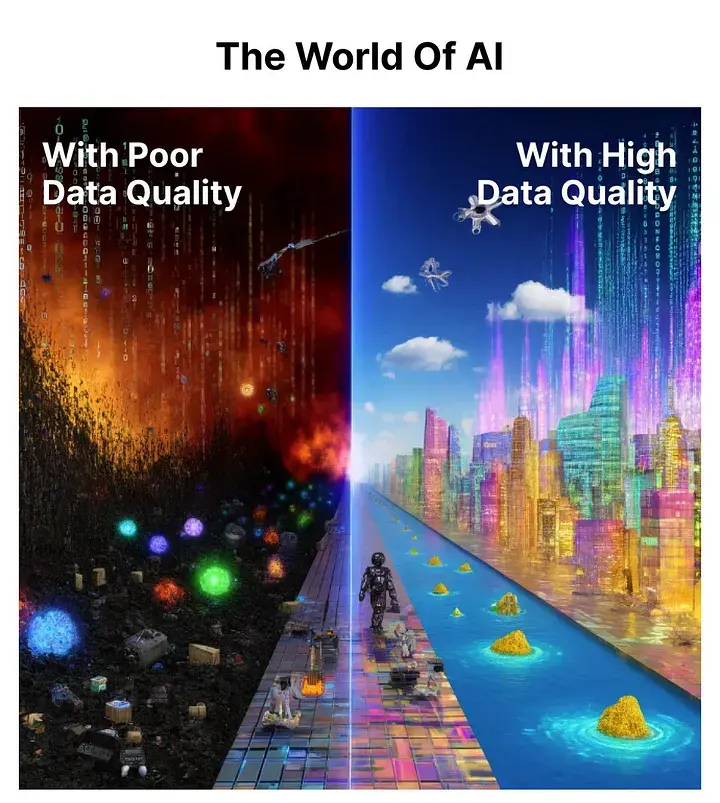
Artificial Intelligence (AI) is changing the game in many fields, from healthcare and finance to transportation and entertainment. But for AI to truly shine, it needs good data. High-quality, clean data is the backbone of any successful AI project. In this article, we’ll dive into why good data is so crucial and look at real-world examples where bad data caused big problems.
The Importance of Correct and Clean Data
1. Accuracy of Predictions and Decisions
AI systems learn from data. When they get accurate, clean data, they can spot patterns and make reliable predictions. But if the data is wrong or messy, the AI might make mistakes.
Take healthcare, for example. If an AI system is trained with incorrect medical records, it could misdiagnose patients or suggest the wrong treatments, putting lives at risk.
2. Reduction of Bias
Data quality has a direct effect on the fairness and bias of AI systems. If the data is biased, the AI will be too, which can worsen discrimination.
For instance, if a hiring algorithm is trained on historical data that includes biases against certain groups, it will keep discriminating against those groups. This results in unfair hiring practices.
3. Enhanced Performance and Efficiency
Clean data helps AI models run smoothly, free from irrelevant or redundant information. This means faster processing times and more accurate results.
In financial services, for example, AI algorithms used for fraud detection must quickly and accurately analyze huge amounts of transaction data. Clean data ensures these algorithms can effectively spot fraudulent activities.
Market Examples of the Impact of Poor Data Quality
1. Tesla & Its Autopilot System
Tesla’s Autopilot system has been involved in several accidents, some of which were caused by the AI misinterpreting road conditions or signs due to poor quality data. In one case, the system mistook a bright sky for a white truck, leading to a fatal collision. This highlights how crucial accurate and clean data is for training autonomous driving systems.
2. Microsoft & Its Tay Chatbot
In 2016, Microsoft launched Tay, an AI chatbot designed to chat with Twitter users and learn from their interactions. Unfortunately, malicious users quickly overwhelmed Tay with offensive and inappropriate data, causing the bot to generate racist and sexist tweets.
This incident underscored the importance of robust data filtering and monitoring mechanisms to ensure that AI systems are trained with clean and appropriate data.
3. Apple & Its Card’s Credit Limit Algorithm
Apple faced backlash when its Apple Card algorithm was found to offer significantly lower credit limits to women compared to men with similar financial profiles. This disparity was attributed to biased data used in training the algorithm, which reflected historical gender biases in credit decisions. The incident emphasized the critical need for unbiased and representative data in AI models, particularly in sensitive applications like financial services.
4. Amazon & Its Recruitment Tool
Amazon developed an AI-powered recruitment tool intended to streamline the hiring process. However, the tool was discovered to be biased against female candidates because it was trained on resumes submitted to the company over a ten-year period, most of which came from men. As a result, the algorithm favored male candidates for technical roles, demonstrating how historical biases in training data can lead to discriminatory AI outcomes.
5. Netflix & Its Recommendation System
Netflix relies heavily on AI to recommend content to its users. However, there have been instances where users received irrelevant or inappropriate recommendations due to inaccuracies in user data or mislabeled content.
For example, if a children’s account mistakenly logs data from an adult profile, the recommendation algorithm might suggest inappropriate movies to a child, underscoring the necessity for clean and accurate user data.
6. Uber & Its Dynamic Pricing Model
Uber uses AI to adjust its pricing based on demand and supply in real-time. However, there have been instances where the dynamic pricing model led to excessively high fares during emergencies or large events, such as natural disasters. These anomalies were often due to incorrect data inputs, such as inaccurate estimations of demand spikes or incomplete data about traffic conditions, which stressed the importance of having clean and reliable data for pricing algorithms.
7. Facebook & Its Ad Targeting
Facebook’s ad targeting algorithms rely on vast amounts of user data to serve relevant advertisements. However, inaccuracies in user data, such as incorrect age, location, or interests, can lead to irrelevant ad placements.
Moreover, Facebook has faced criticism for allowing discriminatory ad targeting due to biases in the training data. For instance, housing ads could be shown disproportionately to certain demographic groups, leading to legal and ethical concerns about fairness and discrimination.
So… What does it mean?
Good data is essential for AI to work well. It makes sure AI systems are accurate, fair, and efficient, leading to reliable predictions and decisions. The examples we’ve discussed show how bad data can cause serious problems, like biased results and safety risks.
As AI keeps growing and becoming a bigger part of different industries, it’s crucial for organizations to focus on data quality. They need to use strict data cleaning and validation processes to get the most out of AI and reduce risks.